

Navigating construction plans in PDF format efficiently utilizes large monitors, eliminating re-measuring and saving valuable time. Understanding scales,
like 1/4 inch, is crucial for accurate interpretation. Mastering this skill unlocks the universal language of blueprints, essential for building trades.
Why Digital Plans are Beneficial
Transitioning to digital construction plans, specifically PDFs, offers significant advantages over traditional paper blueprints. The ability to view plans on a large monitor drastically improves readability and reduces the strain associated with handling large-format drawings. This eliminates the constant need for folding, unfolding, and re-measuring, streamlining the workflow and saving considerable time on-site.
Digital formats facilitate easy zooming and panning, allowing for detailed examination of specific areas without losing context. Furthermore, PDF plans can be readily shared amongst project teams, ensuring everyone is working from the most up-to-date information. Integrated tools within PDF viewers often allow for markups, annotations, and measurements directly on the plan, fostering better communication and collaboration. The convenience and efficiency gains make digital plans an indispensable asset in modern construction.
Moreover, digital plans contribute to a more sustainable practice by reducing paper consumption and waste. This aligns with growing environmental concerns and promotes responsible construction practices.
Understanding the Universal Language of Blueprints
Blueprints, regardless of format – including PDFs – represent a standardized, universal language for the building trade. This language relies on consistent conventions for lines, symbols, dimensions, and views to communicate complex construction details. Successfully “reading” a blueprint isn’t about artistic interpretation, but about accurately decoding these established conventions.

Understanding that blueprints are essentially technical drawings is paramount. They aren’t meant to be aesthetically pleasing, but rather precise representations of a structure. Key to this understanding is recognizing that different line types signify different elements – solid lines for visible edges, dashed lines for hidden features, and so on. Similarly, symbols represent specific components like doors, windows, and electrical fixtures.
Proficiency in blueprint reading involves learning to interpret these visual cues and translate them into a mental model of the finished structure. This foundational skill is crucial for all construction professionals, ensuring accurate execution of designs and minimizing costly errors.

Blueprint Standards and Fundamentals
Essential blueprint standards encompass scales, line types, and views, forming the core of construction documentation. Understanding these fundamentals is vital for interpreting PDF plans accurately and efficiently.
Common Blueprint Scales
Blueprint scales are fundamental to accurately interpreting construction plans presented in PDF format. They define the relationship between measurements on the drawing and their corresponding real-world dimensions. A frequently encountered scale is 1/4 inch equals 1 foot, meaning every quarter of an inch on the blueprint represents one foot in the actual construction.
Other common scales include 1/8 inch equals 1 foot, offering greater detail, and 1/2 inch equals 1 foot, used for larger-scale projects where a broader overview is needed. Recognizing these scales is crucial; misinterpreting them can lead to significant errors during construction. Digital PDF viewers often include tools to assist with scaling and measurement, streamlining the process.
Furthermore, understanding that plans may utilize different scales for various sections is important. For instance, architectural plans might employ a larger scale for detailed interior layouts, while site plans use a smaller scale to depict the overall property. Always check the scale indicated on each sheet before taking any measurements or making interpretations.
Types of Lines and Their Meaning
Decoding construction plans, often in PDF format, requires a firm grasp of line types and their significance. Different line weights and styles convey distinct information about the building elements. Continuous thick lines typically represent visible edges of materials, outlining the form of the structure.
Hidden lines, usually dashed, indicate features obscured from view, such as internal framing or piping. Centerlines, a chain-dot line, mark the axes of symmetry or the center of circular features. Dimension lines, with arrowheads, show the extent of measurements. Extension lines extend from the object to the dimension line.
Understanding these conventions is vital for accurately interpreting the design intent. Digital PDF viewers can sometimes enhance line visibility, aiding in clarity. Ignoring these distinctions can lead to misinterpretations and construction errors. Mastering line interpretation is a cornerstone of proficient blueprint reading, ensuring precise execution of building projects.
Understanding Different Types of Views
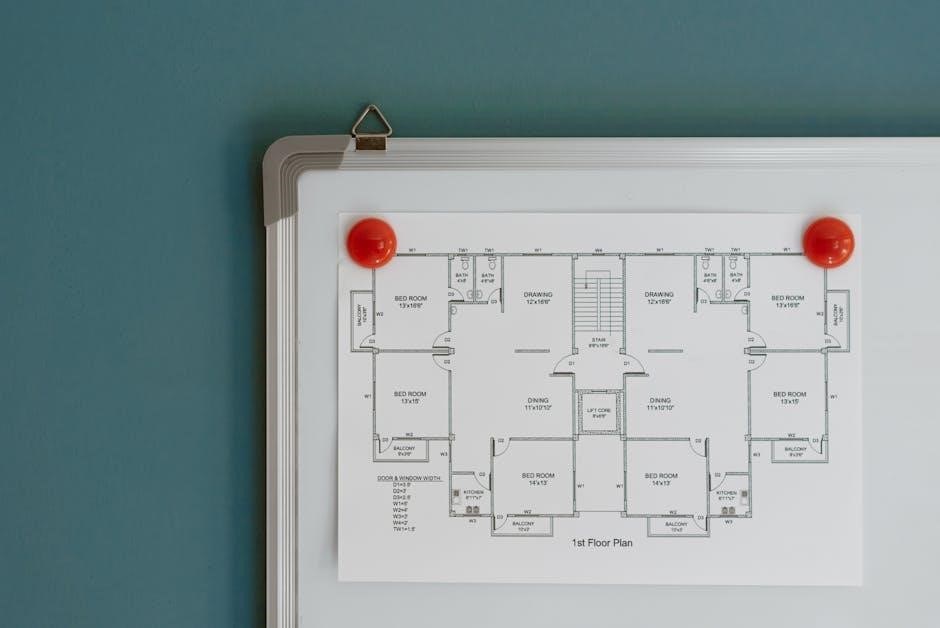
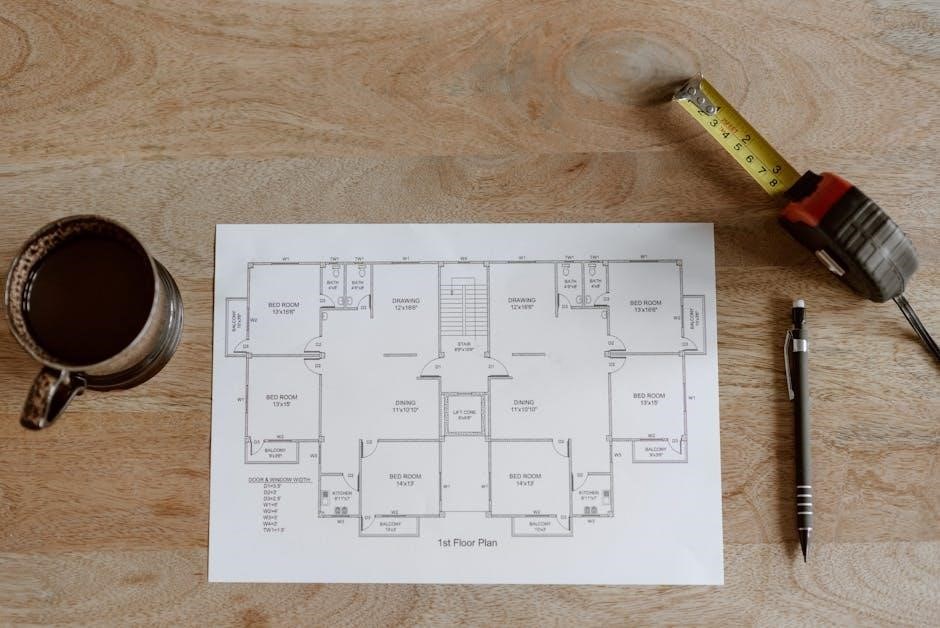
Construction plans, frequently accessed as PDFs, utilize various views to comprehensively represent a building. Plan views, viewed from directly above, depict the layout of each floor, showing walls, doors, and windows. Elevation views present the building from a side perspective, illustrating exterior features and heights.
Section views are cut-through representations, revealing internal construction details like wall composition and floor structures. Isometric views offer a three-dimensional representation, aiding in visualizing spatial relationships. Detail views provide magnified perspectives of specific components, clarifying complex connections.
Successfully reading construction PDFs demands recognizing these view types and their purpose. Digital tools allow zooming and rotating PDFs for better examination. Understanding how these views interrelate is crucial for a complete grasp of the design. Proficiency in interpreting these views ensures accurate construction and minimizes errors, streamlining the building process.

Decoding Construction Drawings
Interpreting construction drawings, often in PDF format, requires understanding dimensions, layouts, and symbols. Accurate measurement and sheet organization are key, alongside recognizing the meaning of various symbols used throughout the plans.
Interpreting Dimensions and Measurements
Accurately deciphering dimensions is fundamental to understanding construction plans, especially when working with PDF versions. Dimensions on blueprints represent precise distances, and are typically noted in feet and inches, often expressed as a fraction. Pay close attention to the units indicated on the drawing – a missing or incorrect unit can lead to significant errors.

Extension lines extend from the object being measured, with a small tick mark indicating the exact endpoint. Dimension lines, with arrowheads at both ends, show the actual measurement. Leaders, lines connecting a dimension to a specific feature, are used for curved or irregularly shaped objects. Understanding these conventions is vital.
When reading digital plans, utilizing software tools to verify measurements can be incredibly beneficial, reducing the risk of misinterpretation. Always double-check critical dimensions and cross-reference them with other parts of the plan to ensure consistency. Remember that scale is paramount; a 1/4 inch equals 1 foot scale means every quarter-inch on the drawing represents one foot in reality. Careful attention to these details ensures accurate construction.
Layout of Construction Drawings – Sheet Organization
Construction drawings, even in PDF format, follow a standardized layout for efficient information access. Typically, a complete set includes architectural, structural, electrical, plumbing, and mechanical plans, each designated with specific sheet numbers. These numbers create a logical sequence, allowing for easy navigation.
The title block, usually located in the lower right-hand corner, provides essential details like project name, address, architect/engineer information, and revision dates. Key plans, often on the first few sheets, offer an overview of the entire project, including site plans and floor plans. Subsequent sheets delve into specific details.
When viewing PDF plans, utilize the layer functionality to isolate specific disciplines – for example, viewing only the electrical plan. Familiarize yourself with common sheet numbering conventions; for instance, A100 series often represents architectural drawings, while S100 series denotes structural plans. Understanding this organization streamlines the process of locating relevant information within the digital document set, improving workflow and reducing errors.
Understanding and Utilizing Symbols
Construction blueprints, including PDFs, rely heavily on standardized symbols to represent various building components and features. These symbols act as a universal shorthand, conveying information concisely and accurately. Successfully interpreting these symbols is paramount to understanding the plans.
Common symbols denote doors, windows, electrical outlets, plumbing fixtures, and structural elements. Digital PDF viewers often allow zooming for detailed examination of intricate symbols; A comprehensive symbol legend is usually included within the drawing set, providing definitions for all used symbols.
When reading plans, always refer to the legend to confirm the meaning of unfamiliar symbols. Failing to do so can lead to misinterpretations and costly errors. Utilizing the search function within the PDF viewer can quickly locate specific symbols and their corresponding definitions. Mastering symbol recognition significantly enhances blueprint reading proficiency and ensures accurate project execution.

Advanced Blueprint Elements
Decoding schedules for doors, windows, and other components is vital. Understanding detailed specifications clarifies material requirements and quality standards. Navigating these elements within PDF blueprints demands focused attention.
Decoding Schedules (Door, Window, etc.)
Schedules are tabular breakdowns providing detailed information about specific building components, like doors and windows, supplementing the graphical representation on blueprints. Within a PDF construction plan, these schedules are crucial for accurate material ordering and installation. They typically include key data points such as size, material, finish, hardware specifications, and fire-rating information.
Effectively reading these schedules requires careful attention to the labeling and corresponding symbols used on the drawings. Each item listed will have a unique identifier that links it directly to its location on the floor plans and elevations. Understanding the abbreviations and codes used within the schedule is also paramount; for example, “WDW” might denote “Window,” and specific numbers could indicate the window’s size or style.
Digital PDF plans often allow for searchable schedules, making it easier to locate specific information. Furthermore, schedules help avoid costly errors by ensuring the correct components are procured and installed, streamlining the construction process. Mastering schedule interpretation is a key skill for anyone involved in building projects.
Understanding Specifications
Construction specifications, often accompanying PDF blueprints, provide detailed written descriptions of materials, workmanship, and quality standards for a project. Unlike drawings which visually represent the design, specifications define how the work should be executed. These documents are critical for ensuring consistent quality and adherence to project requirements.
Within a PDF plan set, specifications are typically organized into sections, categorized by building systems (e.g., concrete, masonry, carpentry). Each section outlines precise requirements, including material properties, installation procedures, and testing methods. Understanding industry standards and codes referenced within the specifications is essential for proper implementation.
Digital PDFs often feature hyperlinked specifications, allowing easy cross-referencing with corresponding details on the drawings. Carefully reviewing specifications alongside the blueprints minimizes ambiguity and potential conflicts during construction. They serve as a legal document, clarifying expectations and protecting all parties involved, ensuring a successful project outcome.
Regulations and Context
PDF plans must adhere to ISO issues, building codes, and local regulations. Understanding these legal frameworks is vital for compliance and safe construction practices. Navigating this context ensures project approval.
ISO Issues, Codes, and Building Regulations
Successfully interpreting construction plans in PDF format necessitates awareness of the governing standards. International Organization for Standardization (ISO) guidelines impact document formatting and data exchange, ensuring consistency across projects. However, these are often superseded by local building codes, which dictate structural integrity, fire safety, and accessibility requirements.
Understanding these codes – often referencing materials, construction methods, and permissible dimensions – is paramount. PDF blueprints should clearly indicate compliance with these regulations, potentially through annotations or linked documentation. Furthermore, plans must align with zoning laws, dictating land use and building height restrictions. Ignoring these regulations can lead to costly delays, rework, or even legal penalties.
Therefore, a thorough understanding of the applicable codes and regulations, alongside the ability to identify their representation on the plans, is crucial for anyone involved in the construction process. This includes architects, engineers, contractors, and inspectors, all relying on accurate plan interpretation for safe and compliant building practices.
The Construction Business Environment & Plan Usage
Within the dynamic construction business, efficient plan usage directly impacts project timelines and profitability. PDF blueprints serve as the central communication tool between architects, engineers, contractors, and subcontractors. Effective interpretation minimizes misunderstandings, reduces errors, and streamlines workflow. Digital plans, viewed on large monitors, facilitate collaborative review and real-time issue identification.
Contractors utilize plans for accurate material estimation, labor allocation, and sequencing of tasks. Subcontractors rely on detailed drawings to perform specialized work, such as plumbing or electrical installations. Project managers track progress against the plans, ensuring adherence to specifications and budget. The ability to quickly locate information within a PDF – utilizing layers, bookmarks, and search functions – is a critical skill.
Furthermore, plans are essential for change order management, documenting modifications and their associated costs. Maintaining accurate as-built drawings, reflecting completed work, is vital for future maintenance and renovations. Ultimately, proficient plan reading is fundamental to success in the competitive construction landscape.

Resources for Further Learning

To deepen your understanding of construction plan reading, several resources are readily available. “Blueprint Reading: Construction Drawings for the Building Trade” by Sam Kubba (9780071549868) offers a comprehensive foundation. Hover Blog provides accessible guides, including a “Complete Step-by-Step Guide for Beginners,” detailing blueprint symbols and layouts. Brandise Construction features Curtis Schmidtberger’s beginner-friendly guide, simplifying the process.
For specialized training, explore the North Carolina Department of Transportation’s “Plan Reading Course” (June 2005), focusing on highway construction plans and step-by-step interpretation. Online platforms like Udemy and Coursera offer courses covering blueprint fundamentals and advanced techniques. Professional Painting Contractors Forum discussions provide practical insights from experienced professionals.
Additionally, consider resources focused on specific building types, such as “Barndominium Blueprint” for detailed floor plans and cost analysis. Remember to supplement your learning with hands-on practice, reviewing real-world construction documents and seeking mentorship from seasoned professionals.